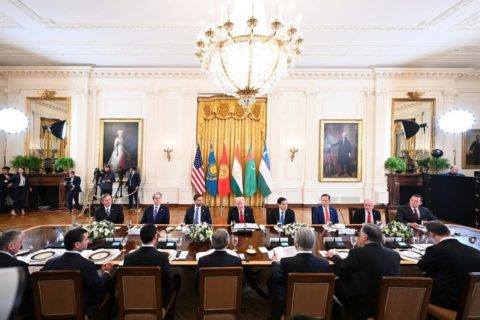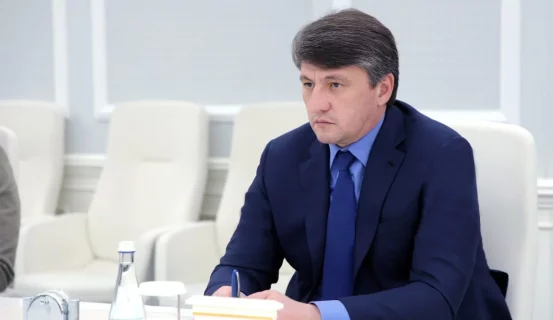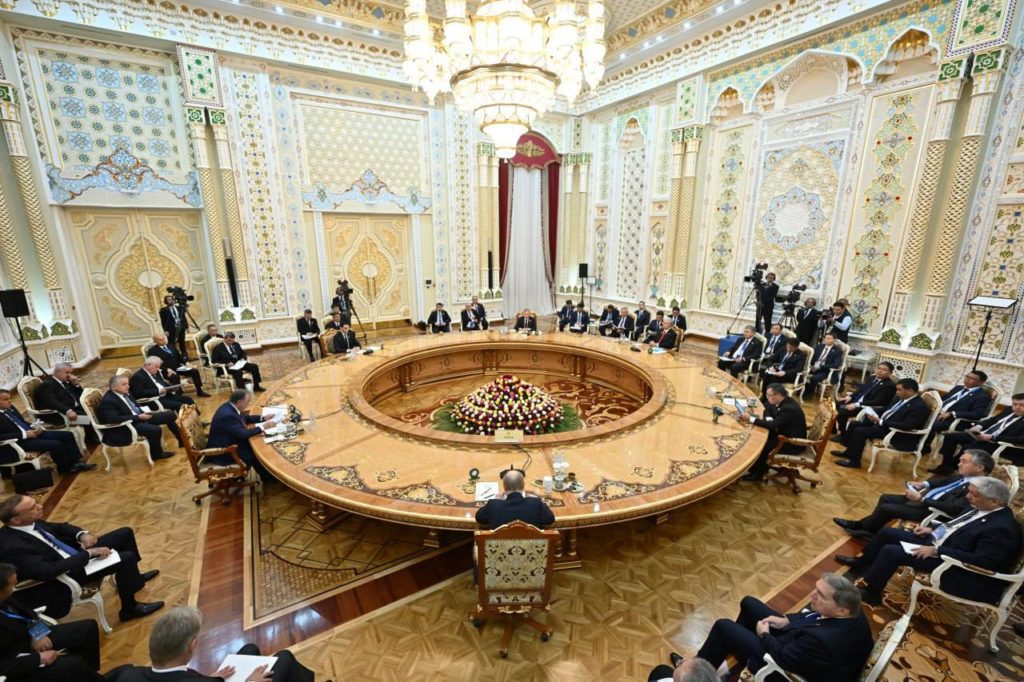
On October 9, Shavkat Mirziyoyev took part in the second summit of the Central Asia—Russia format in Dushanbe, the presidential press service reports.
The heads of state discussed issues of further developing multilateral partnership, expanding cooperation in the political, trade-economic, investment, and cultural-humanitarian spheres, as well as topical aspects of the international and regional agenda. Shavkat Mirziyoyev expressed gratitude to Vladimir Putin for his commitment to developing a full-scale strategic partnership with Central Asia, supporting the initiatives aimed at giving new dynamics to the interaction of the countries.

Russia has been, is, and will always be our key, priority strategic partner and ally. The strong, unshakeable foundation of such cooperation is the common history, centuries-old ties, cultural and mental closeness of our peoples, friendly and trusting relations between our countries, — said Shavkat Mirziyoyev.
The President noted that the growing geopolitical tensions and crisis phenomena in the global economy, as well as emerging new challenges and threats, require closer coordination and cooperation in the Central Asia—Russia format. In this context, the president outlined his vision for the prospects of interaction with Russia.
First of all, the importance of strengthening systematic political dialogue and expanding practical cooperation focused on concrete results was emphasized. In this context, Shavkat Mirziyoyev advocated for holding annual high-level meetings, regular contacts between governments, ministries, agencies, and regions.
Expressing support for the adoption of a Joint Action Plan until 2027, the President proposed to prepare a more detailed “road map” with specific measures to deepen practical interaction. The importance of establishing a Coordination Council at the level of Deputy Prime Ministers was noted for the timely implementation of instructions, preparation, and acceleration of the implementation of programs and projects of regional significance.
The main direction of the region’s joint work with Russia should be the cardinal expansion of economic partnership. Within the framework of the activities of the aforementioned Coordination Council, it was proposed to develop comprehensive measures aimed at increasing the volume of trade turnover.
This includes facilitating mutual access to commodity markets, simplifying procedures, and launching the Agroexpress Central Asia—Russia project. The leader of Uzbekistan also emphasized the vital importance of effectively using the transit and transport potential of the countries, primarily within the framework of the North-South corridor.
We advocate for the alignment of national programs in the areas of road, rail, and air transportation and the development, on this basis, of a comprehensive plan for infrastructural partnership — the Transport and Logistics Contour of the countries.
The ultimate goal should be the formation of an integrated, interconnected regional transport infrastructure that is resistant to external challenges, — the President noted.
Another priority area is the establishment of sustainable production chains and the deepening of industrial cooperation. Uzbekistan is actively expanding industrial partnership with leading Russian companies, implementing large strategic projects in the gas-chemical industry, and creating a modern copper-enrichment hub.
At the same time, it was noted that there are enormous reserves for expanding cooperation in the fields of mechanical engineering, precision instrumentation, chemical, electrical engineering, mining, and other industries on a cluster basis.
To stimulate innovation-oriented cooperation between leading enterprises and the private sector, the creation of the Central Asia—Russia Industrial Engineering Hub in the city of Bukhara has been initiated, which can become a unique technological platform for the development, implementation, and replication of advanced engineering solutions.
Shavkat Mirziyoyev noted the importance of maximizing the use of the opportunities of the “Innoprom. Central Asia” in Tashkent. The fifth exhibition, held in April 2025, brought together over 10,000 participants from 35 countries, with agreements worth $5 billion. It was proposed to give this event the status of the main industrial and innovation platform in the Central Asia—Russia dialogue format.
As the head of Uzbekistan emphasized, energy cooperation with Russia will continue to be a factor in the stability and sustainability of the region. Today, strategic projects are being implemented, including the development of gas pipelines and energy infrastructure.
On these days, a historic event will take place — the launch of joint projects for the construction of the first reactor unit of the future nuclear power plant and a multifunctional Nuclear Medicine Center in Uzbekistan, — the President said.
It was proposed to establish broad scientific and practical cooperation in this direction – to establish a Regional Center for Competencies in Atomic Energy in Uzbekistan, as well as to adopt a Program for Training Personnel on the basis of the Tashkent branch of the Moscow Engineering Physics Institute.
The intention to expand cooperation in the field of exploration and processing of hydrocarbons, modernization of the electric power industry, and the introduction of energy-efficient solutions was also announced. In order to transfer advanced knowledge and technologies, prepare and promote joint projects, it is advisable to develop a comprehensive Program “Energy Partnership of Central Asia and Russia”. In the field of innovation, it was proposed to open branches of the Skolkovo Center in the countries of the region.
The need to establish a Regional Expert Council on Artificial Intelligence and Digital Technologies was also noted, which will allow for the consolidation of efforts and the establishment of project cooperation at the level of leading centers, organizations, and IT companies. In order to enhance humanitarian cooperation, it was initiated to hold an annual ethnocultural forum — the Festival of Culture, Art and Creativity of the Peoples of Central Asia and Russia.
In addition, it was proposed to launch a scientific and educational Consortium “Engineers of the Future”, designed to unite the potential of leading universities and research structures for the implementation of a dual and vocational education system, fundamental scientific developments. It was noted that the successfully operating branches of Russian universities in the countries of the region can become the intellectual base of the Consortium. In Uzbekistan, their number is already 15.
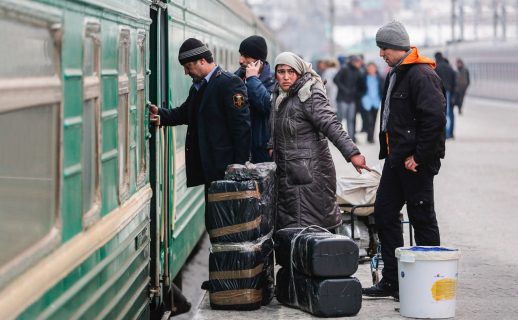
It was also proposed to establish a Special Grant Program for young researchers and scientists from Central Asia and Russia. For the development of comprehensive cooperation, the relevance of adopting programs in the field of child and maternal health protection, promoting social adaptation in the field of labor migration, as well as expanding tourist flows based on regional routes, was noted. The President separately addressed the issues of ensuring regional security.
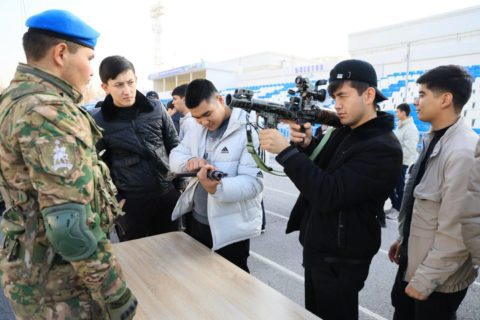
We consider it important to further enhance the close interaction of special services and law enforcement agencies in combating terrorism, extremism, radicalism, organized crime, human trafficking, and drug trafficking. We propose to jointly develop measures to counter new cyber threats and challenges, — the country’s leader said.
In order to coordinate approaches to expanding cooperation and promoting the socio-economic development of Afghanistan, it was proposed to consider the possibility of holding high-level consultations. The agenda of these meetings could include issues of cooperation in the field of security, the implementation of economic projects designed to ensure the stability and development of this country.
At the end of his speech, the President of Uzbekistan reaffirmed his commitment to further expanding multifaceted cooperation with Russia in the interests of ensuring security, sustainable development, and prosperity of all countries in the region. Following the event, a Joint Communiqué and a Joint Action Plan for 2025-2027 for the further development of cooperation in priority areas were adopted.