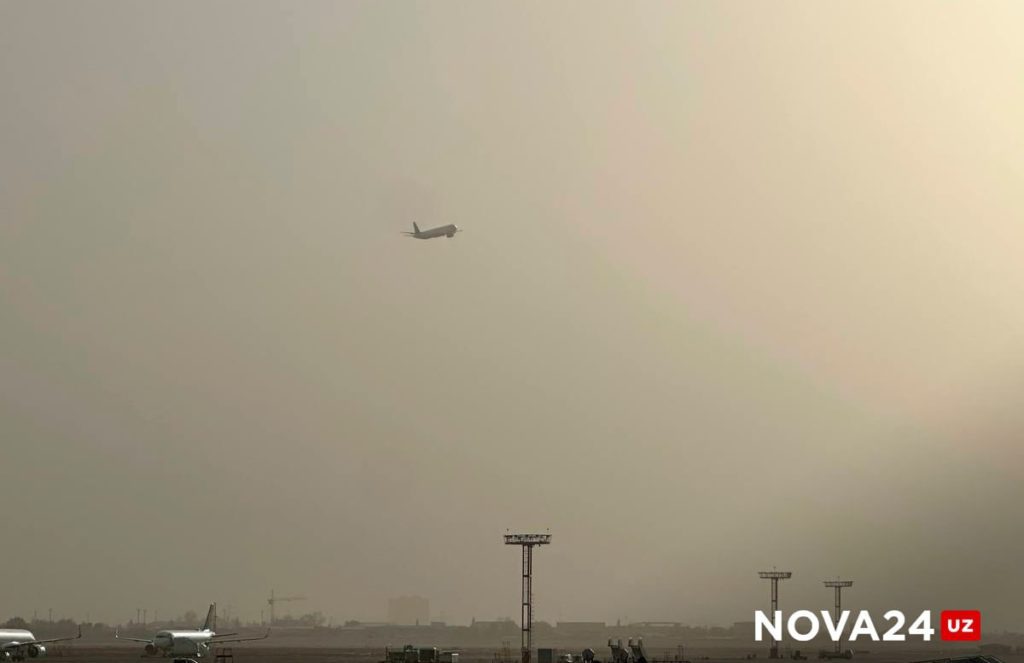
The Ministry of Ecology commented on the severe deterioration of air quality in Tashkent.
On September 21, a low-pressure zone with a small gradient (1010 gPa) formed over the center of the country. This has caused daytime temperatures to rise to 35°C in the Samarkand, Jizzakh, Syrdarya, and Tashkent regions. In the south of the Tashkent region, the maximum values exceeded 35°.

This warming contributed to the penetration of the western frontal winds of a cold anticyclone with a pressure center of up to 1028 gPa, which moved across the Caspian Sea on the night of September 21, — the report said.
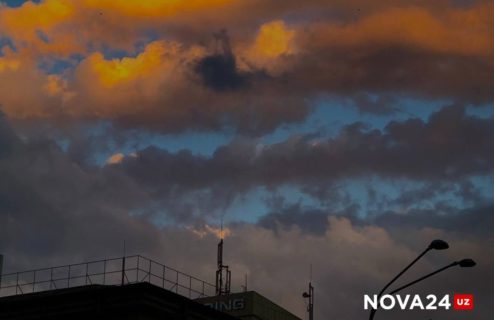
On the morning of September 22, strong westerly winds in the eastern part of Navoi region and in the Aydarkul lake system area shifted their direction from the Chardarya reservoir area to the north. In the second half of September 22, dust masses from the eastern Kyzylkum, the Aydarkul region, and the southern regions of Kazakhstan reached Tashkent.
From 15:00 on September 22, the concentration of fine-disperse particles PM2.5 and PM10 began to increase in the southwestern districts of the capital. Thus, the Horiba automatic station near the Uchtepa district administration registered 142 μg/m3 of PM2.5 — 4 times higher than the national norm (35 μg/m3).
As of 16:00, a southwesterly wind of 4 m/s contributed to the spread of dust particles to the city center and northeast. In the “Yangi Uzbekistan” park, an automatic station recorded an increase in the maximum permissible concentration of PM2.5 by half (68 μg/m3). At the same time, visibility at the international airport decreased to 5 km.
By 18:30, indicators at automatic stations across the city recorded a sharp increase in PM2.5 concentration to 150 μg/m3. This is 5 times more than the norm. Visibility at the airport has worsened to 4 km.
A cold anticyclone with a pressure of up to 1025 gPa passes through the central regions of the republic. He will determine the weather until September 24. However, it is not capable of completely “cleaning” the air of Tashkent from accumulated particles. On the contrary, air currents will gradually settle them closer to the surface.
In the morning and evening hours of September 23-24, due to the inversion, PM2.5 levels may rise again. Only on the night of September 24th, with the departure of the anticyclone and the arrival of new cyclonic processes, is it possible to quickly clear the air in the capital.
It’s worth noting that as of 08:00 on September 23rd, breathing was harmful in Tashkent. In the ranking of the world’s most dirty cities, the capital entered the top five. The content of finely dispersed PM2.5 particles was 66 μg/m³, exceeding the WHO recommended value by 13.2 times.